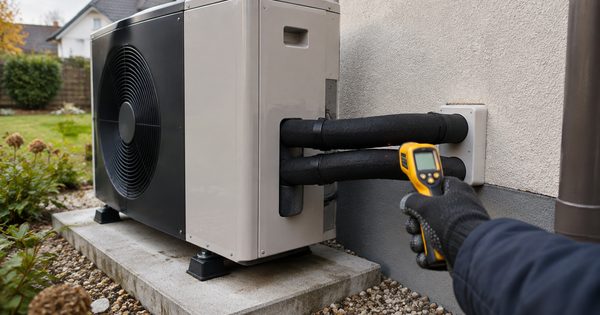
Heat survey, radiators and flow temperature, cost of useful heat, investment and ownership costs, support available in England, planning responsibilities: how to compare heating quotations before signing.
Information checked on 27 October 2026
The cheapest heating system to buy is not necessarily the cheapest to own. Before asking for a replacement boiler or heat pump price, establish how much heat your home needs, how that heat will reach each room and what the complete installation will cost. There is no single technology that wins for every property.
This guide is for homeowners in England. It explains how to compare the main options, interpret running cost estimates and check a quotation before committing. The references and scheme information were checked on 27 October 2026. Grant arrangements elsewhere in the United Kingdom should not be assumed to apply in England.
Start with a survey of your home
Collect your recent energy bills, details of insulation work and information about the existing boiler, radiators and hot water system. Tell the installer which rooms are difficult to heat, your usual heating schedule and whether an extension or other building work is planned. Ask how the design would change if you improve the insulation first.
A room by room heat loss calculation is an important starting point for sizing a heat pump. MCS explains that this assessment takes account of the building fabric, room dimensions, ventilation, desired indoor temperatures and winter outdoor conditions. A floor area alone cannot describe all of those factors. [1]
Ask for a clear distinction between power and energy. The equipment's output in kilowatts, or kW, indicates the rate at which it can provide heat. Annual demand in kilowatt hours, or kWh, describes a quantity of heat over time. A bigger number on a product brochure does not establish that the equipment is more economical.
Compare solutions that can actually serve the property
An air-to-water heat pump supplies a wet heating system and can heat stored domestic hot water. Its practicality depends on the proposed installation, including space and the way hot water will be provided. Ask the installer to show where each component will go, particularly when replacing a combi boiler. [3]
Option
When to investigate it
Main comparison to request
Air-to-water heat pump
A replacement for a wet central heating system
Complete system design and seasonal electricity use
Ground source heat pump
A site with suitable space and feasible ground works
Source installation costs and the whole heating proposal
Replacement boiler
A comparison against the current arrangement
Full installation cost and expected fuel consumption
Direct electric or storage heating
A property where a wet system is impractical
Tariff, controls, heat demand and annual running cost
Air-to-air heat pump
A layout that can be served by warm air
Room coverage and a separate hot water solution
Direct electric heating can be comparatively straightforward to install, while its running cost can be significant when heating a whole home with high demand. Storage heating uses a different charging pattern and needs a suitable tariff. Energy Saving Trust recommends considering both installation and use when comparing these systems. [4]
If a communal heating system or local heat network is available, request its full contract and annual cost breakdown as another option. Include standing charges and service charges, not just the unit price of heat. A proposal that is economical for one building should not be transferred unchanged to another.
Check radiators and flow temperature
A heat pump does not automatically require underfloor heating or the replacement of every radiator. Ask which existing emitters can deliver enough heat at the proposed design flow temperature and which require alteration. The designer should connect the room's calculated heat loss to the radiator or other emitter selected for it.
Energy Saving Trust's technical guidance links accurate room calculations with correct emitter sizing and efficient operation at a relatively low flow temperature. It also explains why both undersizing and excessive oversizing can create problems. The quotation should therefore state the design assumptions, rather than simply promising a powerful unit. [2]
Ask what seasonal performance is expected for your system, including any supplementary electric heating. A product COP measured at one operating point is different from performance over an entire heating season. Any advertised SCOP should be interpreted with its specified test conditions; it is not a guarantee of the electricity bill in your house.
Work out the cost of useful heat
Comparisons become clearer when every proposal is asked to deliver the same amount of useful heat. For a heat pump, the variable electricity cost per kWh of heat is approximately the electricity unit price divided by the assumed seasonal performance factor. For a boiler, divide the fuel unit price by its seasonal efficiency. Use a consistent energy basis for the fuel and efficiency figures.
Here is a worked example using deliberately chosen assumptions. These figures are not current market tariffs, an installation quote or a forecast for an English home. Suppose the annual space heating requirement is 9,000 kWh, electricity costs 28 pence per kWh and gas costs 7 pence per kWh. Assume boiler efficiency of 90 per cent and a heat pump seasonal performance factor of 3.5.
The boiler would require 10,000 kWh of gas, costing £700. The heat pump would require approximately 2,571 kWh of electricity, costing £720. With these assumptions the heat pump's variable energy cost is £20 higher. If its seasonal factor were 4.0 instead, the electricity cost would be £630, or £70 lower than the boiler calculation.
These arithmetic results show why a promise of automatic savings needs supporting assumptions. The example excludes hot water, standing charges, servicing, installation, financing and differences in other electricity use. A complete comparison must include them. Removing a gas boiler also does not remove gas standing charges if the gas supply remains in use.
Ask each installer to show a central estimate and a less favourable case, using the same tariffs and heat demand. Check whether time-of-use prices assume that heating can be shifted into cheap periods without losing comfort. A simple annual average tariff may hide expensive periods when the equipment needs to operate.
Compare the complete investment and ownership costs
Request an itemised price for the survey and design, equipment, labour, radiator or pipe alterations, electrical work, hot water provision and removal of the old equipment. Identify any decorating or building work that remains your responsibility. A headline appliance price is not a complete installed price.
For a chosen comparison period, add the net installation cost, energy, servicing and expected maintenance. Show finance charges separately and state whether any replacement of major components has been allowed for. Deduct only a grant for which eligibility has been checked. Keep a separate note of uncertain future costs.
This is a decision method, not a claim that fuel prices or repair costs can be forecast precisely. Ask whether the conclusion still holds if electricity becomes dearer relative to gas, the installation performs less efficiently than expected or the building's use changes. The preferred solution should remain understandable when those assumptions are visible.
Check support available in England before committing
The Boiler Upgrade Scheme operates in England and Wales and provides support for eligible installations. It is installer led: an MCS certified installer applies on the property owner's behalf. Ofgem explains that the grant should be reflected as an upfront discount on the quotation. The applicable technology, property and scheme conditions must all be checked. [5]
Before signing, ask the installer to confirm the proposed eligibility, the grant amount being assumed and the application timetable. Ask what happens to the contract and your payment obligation if funding is not approved. The gross price, grant deduction and amount you will pay should be easy to distinguish.
Do not assume that a hybrid system retaining a fossil fuel boiler qualifies for the scheme; Ofgem excludes such hybrid systems from BUS support. Equally, do not apply funding advertised for Scotland to an English property. Check the current Ofgem guidance for the exact installation and commissioning arrangements before placing an order. [5]
Resolve planning and installation responsibilities
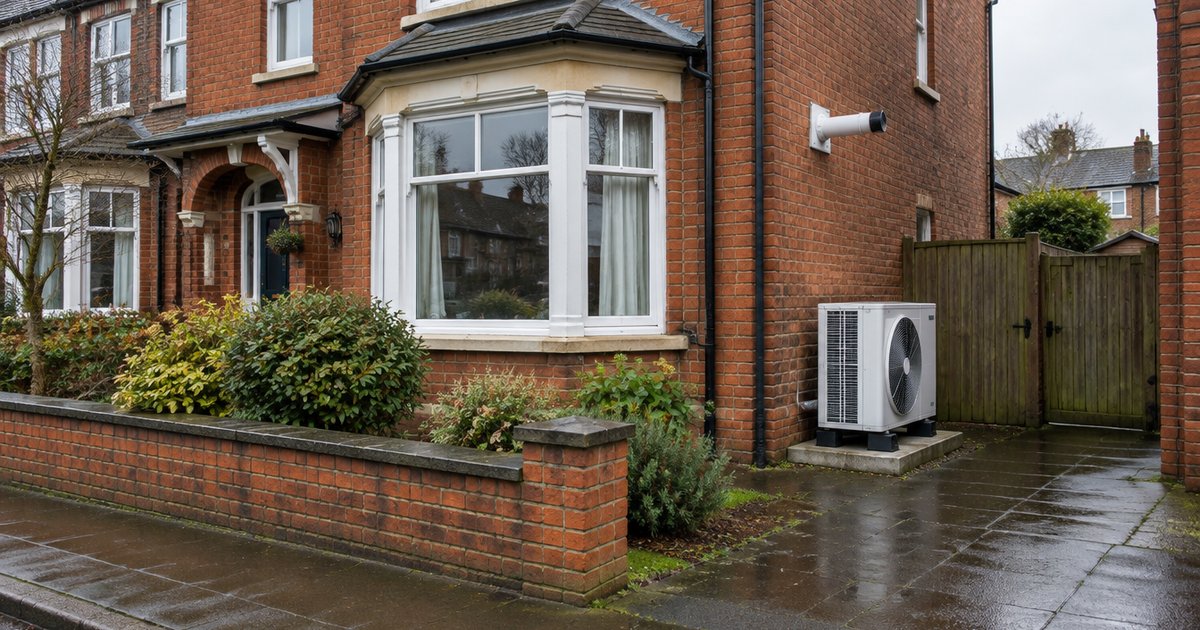
An air source heat pump can fall within permitted development rights in England, but this depends on meeting the applicable limits and conditions. The rules were amended in 2025, including changes affecting unit size and the number permitted on certain properties. Older advice about a universal distance from a boundary should not be treated as a complete current assessment. [7]
Ask the installer to record how the proposed location meets the current requirements, including the relevant acoustic assessment. Check with the local planning authority where the position is uncertain, particularly for a listed property or another restricted site. Confirm any separate building regulations approval or competent person certification arrangements. GOV.UK advises checking planning requirements before proceeding. [6]
The design should also explain access for servicing, vibration control and condensate disposal. Where work on a gas installation is included, it must be carried out by someone appropriately registered with Gas Safe. Verify that the registration covers the work proposed. [9]
Compare quotations before signing a contract
The Competition and Markets Authority advises consumers to compare accredited businesses, seek several quotations and obtain written support for important claims. Its guidance also emphasises understanding the complete price. A certificate or a confident sales presentation should be the start of your checks, not the whole assessment. [8]
Check the installer's current credentials and who will actually carry out the work. GOV.UK recommends choosing an MCS installer when seeking support such as BUS. Also clarify responsibilities if electrical work, ground works or other tasks will be subcontracted. [6]
Before signing, have the quotation analysed through ecvcheck.com with ECV – Euro Construct Verify. Use the findings as an additional check on the price breakdown, technical consistency and questions about the contractor. Ask the installer to resolve any uncertainties in writing.
- Named equipment, model references, design output and the assumptions behind predicted energy use.
- The included radiators, pipework, controls, hot water equipment and electrical works.
- A complete installed price with VAT treatment, exclusions and optional work stated clearly.
- Responsibility for permissions, funding paperwork and any third party approvals.
- Installation dates, payment stages, warranties and servicing requirements.
- Commissioning records, operating instructions and an agreed handover explaining the controls.
Keep the final specification and quotation together. If the design changes, ask for an updated written price before agreeing to additional work. Do not rely on a verbal assurance that an omitted item will be included later. The final contract should describe the installation you expect to receive.
Three questions to ask before choosing
Will a heat pump definitely reduce my bills? No single saving can be promised for every property. Ask for a calculation using your existing heating system, expected seasonal performance, tariff and hot water needs. Compare the complete annual cost rather than one selected efficiency figure.
Can an older home use a heat pump? Its age alone does not settle the question. A survey should establish the actual heat losses, emitter capacity and necessary improvements. Discuss which changes are essential to the proposed design and which are optional future upgrades.
Should I sign quickly to secure a discount? Take time to check the scope and conditions. GOV.UK advises that installers should not pressure customers to sign immediately. A clear specification and an accountable installer are more useful than an unexplained offer that expires during a sales visit. [6]
Make the choice specific to your home
A sound heating decision combines a suitable design with a price you can understand and running cost assumptions you can test. Compare like for like, confirm funding and resolve omissions while the contract is still negotiable.
Before accepting the quote, use ecvcheck.com and ECV – Euro Construct Verify for an additional analysis. It supports your review and does not replace a site survey, heating design or confirmation of grant eligibility. Have outstanding questions answered before you sign.
Sources and further information for England
Sources accessed on 27 October 2026
- [1] Microgeneration Certification Scheme — Understanding Heat Loss. heatloadcalculator.mcscertified.com
- [2] Energy Saving Trust — Heat loss calculations detailed guidance. greenheattoolkit.energysavingtrust.org.uk
- [3] Energy Saving Trust — Air source heat pumps. energysavingtrust.org.uk
- [4] Energy Saving Trust — Electric heating. energysavingtrust.org.uk
- [5] Ofgem — Boiler Upgrade Scheme Property owners. www.ofgem.gov.uk
- [6] Department for Energy Security and Net Zero — Find a heat pump installer. www.gov.uk
- [7] UK legislation — The Town and Country Planning General Permitted Development England Amendment Order 2025 Article 5. www.legislation.gov.uk
- [8] Competition and Markets Authority — Buying green heating and insulation products a consumer guide. www.gov.uk
- [9] GOV.UK — Register to carry out gas work. www.gov.uk