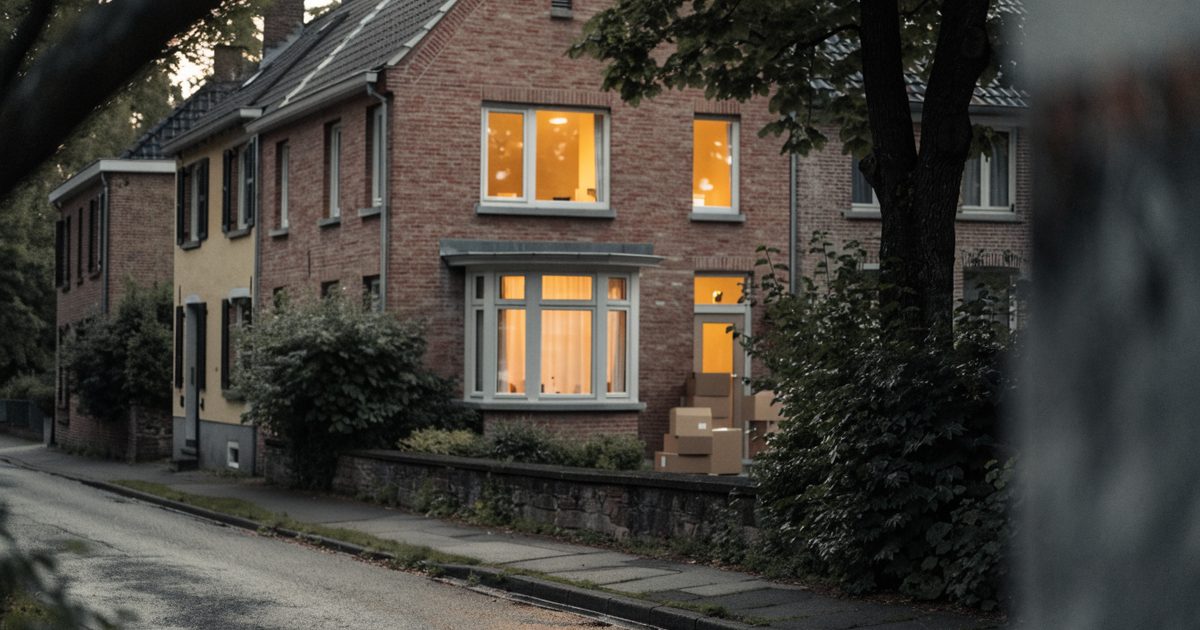
Behind a renovation quote, there's often a life-changing project financed by a loan. ECV was created to prevent an unfinished building project from turning into a financial disaster.
Behind a renovation or construction quote
Behind a renovation or construction quote, there aren't just figures, square metres, materials and labour.
There's often a life-changing project.
A family finally renovating their house. A young couple buying their first home. Parents extending their property because a child is on the way. A retiree investing their savings to adapt their home. A homeowner replacing a roof, installing solar panels or improving their property's insulation.
And very often, to carry out this work, these people use their savings or take out a loan that they will have to repay over several years.
Fortunately, most projects go well. There are excellent tradespeople and reputable companies all over Europe. But when things go wrong, the consequences can be dramatic.
The building work stops. The loan, however, continues.
It's probably one of the most unfair situations a consumer can face.
The company receives a large deposit. The work begins. Then the delays start to pile up.
The contractor asks for an additional payment. The work progresses much more slowly than planned. Poor workmanship becomes apparent. Some services that have been invoiced don't match the quote. The company runs into financial difficulties or, in the most serious cases, disappears or goes bankrupt.
The building site is left unfinished. But the bank doesn't disappear.
Every month, the loan repayments continue to be taken.
The consumer can then find themselves in a terrible situation: repaying a loan for years for work that was never finished, while also having to find more money to get another company to take over the project.
Sometimes, they have to take out a second loan. Sometimes, a lifetime of savings disappears. And sometimes, behind the financial problem, an entire family suffers.
These are the situations ECV wants to help prevent
Euro Construct Verify – ECV was born from a very simple idea: before signing a quote and paying several thousand or tens of thousands of euros, a consumer should be able to check what they are about to sign.
It seems obvious. Yet in reality, many people still choose a contractor based mainly on a quote, a few conversations, a website, online reviews or a recommendation.
But a quote for building work can contain many areas of uncertainty:
- an unusually high or, conversely, an unusually low price;
- services that are not detailed enough;
- inconsistent quantities;
- poorly defined materials;
- disproportionate deposits;
- a risky payment schedule;
- unfavourable clauses;
- missing technical details;
- a company with certain red flags that should prompt further checks.
Taken individually, each of these elements is not necessarily a cause for concern. But before you sign, you need to know what you're signing.
This is precisely where ECV comes in.
European consumers are already looking for these answers
We realised this by studying the questions and searches consumers make on the internet.
The words change depending on the country and language. But most importantly, the concerns are not exactly the same across Europe.
In the United Kingdom, for example, consumers search for phrases like: “check builder quote” or “check my quote”.
Behind these few words typed into a search engine lies a much more important question: “Can I trust this quote before I commit?”
In Germany, the behaviour is noticeably different. German consumers seem to focus their searches more on comparing offers, with searches such as: “Angebot Handwerker vergleichen”.
In other words: comparing quotes from tradespeople.
Germany: more comparison, in a more regulated legal environment
The German market has its own specific features. The contractual framework for building work and trade services is relatively structured, and German consumers traditionally pay close attention to the content of the Angebot (quote), the description of services and the comparison between several professionals.
The issue is therefore not necessarily framed in the same way as in the United Kingdom.
Where a British consumer might search “Can I trust this builder quote?”, a German consumer is more likely to try to determine: “Ist dieses Angebot angemessen?”, “Handwerker Angebote vergleichen” or “Angebot Handwerker vergleichen”.
That is: is this offer reasonable, and how does it compare to other available offers?
This difference perfectly illustrates one of ECV's fundamental principles: you cannot analyse the needs of European consumers as if there were a single, homogeneous construction market.
A European ECV cannot be a simple system translated into several languages
Translating a French platform into German, English, Dutch, Spanish or Italian is not enough.
Localising is not the same as translating.
Contractual practices differ. Consumer expectations differ. Legal rules differ. Invoicing methods can differ. The deposits requested differ. The documents given to clients differ. Technical standards and certain professional obligations differ.
And above all, the questions consumers ask themselves before signing are not exactly the same.
This is why the ECV teams precisely analyse the behaviours, searches and specific needs of consumers on a country-by-country basis.
Our goal is not to impose a single method across Europe. Our goal is to understand what really worries a British, German, Belgian, French, Spanish, Italian, Dutch or Portuguese consumer in their own environment.
This country-by-country approach is essential for building a truly relevant analysis.
Behind an internet search, there is sometimes a person who is afraid of making a mistake
An internet search seems anonymous. A few words. A question. A click.
But behind that search query, there may be someone about to pay €10,000, €30,000, €80,000 or more.
Someone who knows nothing about construction. Someone who doesn't know if the price quoted for their roof, window frames, electrical installation, insulation, heat pump or solar panels is reasonable.
Someone who is hesitant to sign. And sometimes, unfortunately, someone who is looking for this information after they have already signed.
It is precisely this last situation that we would like to see become increasingly rare.
Check before you sign
In many important areas of our lives, we check before we buy. We compare cars. We check hotels. We compare insurance policies. We look up the specifications of a phone that costs 1,000 euros.
But when it comes to a building project that can be worth tens of thousands of euros, many consumers still have to make a decision based on documents they are not technically able to interpret.
This is an anomaly. ECV wants to help correct it.
Our goal is to use technology, available data and artificial intelligence to provide the consumer with an additional, independent review before they commit.
This is not about claiming that a system can guarantee a project will go perfectly. No one can seriously guarantee that.
It's about doing something much more concrete: identifying as early as possible the elements that deserve to be checked before any money is committed.
A few minutes of checking can prevent years of problems
The best dispute is one that never happens. The best abandoned project is one where the warning signs were spotted before signing. The best lost deposit is one that was never paid.
This preventative approach is at the heart of ECV.
We would rather a consumer asks ten questions before signing than desperately searches for ten solutions after paying.
Because once the work has stopped, the options become much more complex: surveyors, solicitors, formal notices, legal proceedings, a new contractor, new quotes and sometimes new financing.
And in the meantime… the loan repayments continue.
Our ambition is European — our approach is local
Problems with building work obviously don't stop at borders. But how they manifest, consumer habits, and the answers they require can change considerably from one country to another.
This is why ECV pursues a European ambition while developing a local understanding of each market.
A British, Belgian, French, German, Spanish, Italian, Dutch, Portuguese or Swiss homeowner may ultimately ask the same fundamental question: “Can I reasonably sign this quote?”
But they won't necessarily phrase it in the same way, and the elements needed to answer it will also depend on their country.
Regulations, prices, business practices, standards and contractual habits differ.
ECV therefore analyses the quote in its context, not just as an isolated document.
ECV is not against contractors
This is a key point.
ECV is not intended to pit consumers against construction professionals. Quite the opposite.
The vast majority of reputable tradespeople and companies also suffer from the practices of a few unscrupulous players.
A clear, consistent and professional quote should be an advantage for the company that prepared it. Transparency therefore protects both parties.
The serious consumer and the reputable contractor ultimately have the same interest: to know exactly what needs to be done, at what price, and under what conditions.
Why ECV?
Because we have seen the questions that consumers ask.
Because we see that these questions differ from one European country to another.
Because a Briton searching for “check my quote” and a German searching for “Angebot Handwerker vergleichen” are not expressing exactly the same need, even if both are looking for more security before committing.
Because behind these searches lie genuine concerns.
Because a quote of just a few pages can commit a family for several years.
Because an abandoned building project can become a financial nightmare.
Because a person can lose their deposit, have to find a new contractor, and still have to continue repaying their first loan.
Because it is infinitely smarter to spend a few minutes checking beforehand than to spend several years trying to fix the consequences afterwards.
And because a true European solution must understand the realities of the British, German, French, Belgian, Spanish, Italian, and Dutch markets, and those of every market in which it operates.
It is this knowledge that our teams are constantly building and refining.