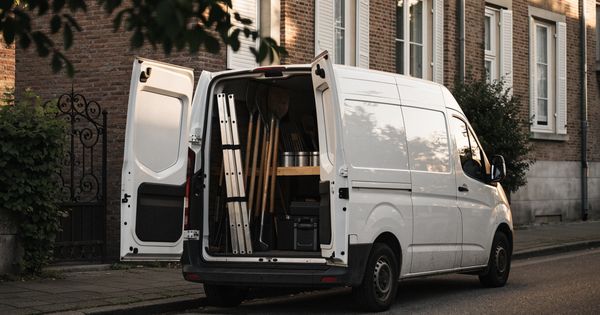
A smart-looking van and fifty positive reviews say nothing about a company's financial health. Here are the checks to carry out, country by country, before paying a deposit.
You've found a contractor. The quote seems reasonable, the Google reviews are good, and the salesperson seems trustworthy.
But how can you know if this contractor is truly reliable before you sign and pay a deposit?
This is probably one of the most important checks to make before starting any work.
A smart-looking van, a professional website and fifty positive reviews don't tell you whether a company is financially sound, properly registered, insured for the proposed work, or facing administrative difficulties.
In 2026, much of this information can be verified. And in many European countries, the initial checks are free.
Here's how to do it.
1. Always start by checking that the company actually exists
It sounds obvious. Yet, the first step before signing a quote for building work is to check that the name on the quote matches an officially registered company.
You should compare: the legal name; the company number; the VAT number; the registered address; the identity of the contractor; the legal structure; its active or dissolved status; the date of incorporation; and the officially declared business activities.
Any inconsistency between the quote and the official register should immediately raise questions.
For example: you receive a quote from 'DUPONT RÉNOVATION', but the VAT number provided actually belongs to 'DUPONT SERVICES SRL', whose declared activity doesn't seem to match the proposed work. This doesn't automatically prove fraud, but before paying a €10,000 deposit, it's reasonable to ask for an explanation.
2. Check how long the company has been in business
A company established six months ago isn't necessarily bad. Conversely, a company founded thirty years ago isn't automatically reliable.
But the company's age is an important piece of information. If a contractor claims, 'We have over 20 years of experience', but the company on the quote was set up eight months ago, ask for an explanation.
It could be due to a change of company, a business takeover, a transition from sole trader to a limited company, a merger, or a new corporate structure.
Also, where this information is legally accessible, check if the directors have previously run other construction companies that have been liquidated or declared bankrupt.
3. Check that the company actually carries out the proposed activity
An officially registered company is not necessarily competent to carry out all types of work.
A contractor might offer roofing, electrical work, heating, plumbing, insulation, photovoltaic panels, waterproofing, or complete renovations.
Check if these activities genuinely match those declared and, where national law requires it, if the company holds the necessary qualifications, registrations, or authorisations.
4. Check the European VAT number
For a European company, the intra-Community VAT number can be checked using the European VIES system.
Warning: a valid VAT number doesn't mean the company is financially sound or competent. It's just an additional check.
5. Check the accounts and financial situation where accessible
A company can have a high turnover but also huge debts, very little cash, negative equity, several loss-making years, late filings, or be involved in insolvency proceedings.
You don't need to be a chartered accountant. A few warning signs deserve special attention: repeated losses + severely depleted equity + missing filings + legal or insolvency proceedings = caution.
The risk becomes particularly significant when the company asks for a large deposit.
6. Belgium: how to check a contractor before you sign?
Belgium has several particularly useful tools.
Banque-Carrefour des Entreprises – BCE
The first check should be done with the Banque-Carrefour des Entreprises (BCE).
The Public Search of the FPS Economy allows you to consult a lot of public information for free: company number, name, status, address, legal form, start date, NACEBEL activities, establishment units, certain legal functions, certain authorisations and legal situation.
The BCE can also report certain automatic de-registrations.
Absolutely check: the BCE number on the quote must correspond to the company you think you are contracting with. Then check the NACEBEL activity codes.
7. Belgium: check the withholding obligation – article 30bis
This is a particularly useful check in Belgium.
The system, linked in particular to article 30bis, allows you to check whether a contractor active in the relevant sectors is subject to a withholding obligation due to certain social security or tax debts.
The official service is 'Check Obligation de retenue'. In 2026, the system evolved further with the inclusion of certain debts related to the social security status of the self-employed.
The check can be carried out using the company's BCE number or, in some cases, the identifier of a foreign company.
For ONSS social security debts, the withholding can be as high as 35% of the invoice amount excluding VAT. For certain tax debts, the withholding is 15% excluding VAT. Since the scheme was extended to the social security debts of the self-employed, a 15% withholding may also apply in the relevant context.
Warning: the withholding obligation does not apply in the same way to a private individual having work carried out for strictly private purposes. Therefore, you should not treat the result of this check as an automatic legal conclusion.
For professional clients covered by the regulation, the check must be carried out when the contract is concluded and before the relevant payments are made.
8. Belgium: also consult the annual accounts
For companies required to file accounts, the annual accounts filed with the National Bank of Belgium (BNB) allow you to dig deeper.
Look in particular at: equity, profit or loss for the year, debts, cash flow, retained losses and the evolution over several years.
A single bad year obviously doesn't mean a company is going to go bankrupt. But three or four very difficult years warrant more attention when you are asked for a deposit of several tens of thousands of euros.
9. France: how to check a tradesperson?
In France, start by checking the company's existence and its SIREN/SIRET number in the official registers.
For certain types of work, also check the professional liability insurance, the decennial liability insurance where legally required, the validity period of the insurance, the activities actually covered, the advertised qualifications and the RGE label when it is necessary for the project or for certain grants.
A certificate of insurance is not enough: the type of work shown on the certificate must correspond to the work the company will actually carry out.
10. Spain: Registro Mercantil and REA
In Spain, for companies, you should consult the information available via the Registro Mercantil.
In the construction sector, the Registro de Empresas Acreditadas – REA is also an important tool. It allows you to check the registration of companies operating in the construction sector and covers, in particular, certain capacity and occupational risk prevention requirements.
11. Portugal: check the IMPIC
In Portugal, a particularly useful check for construction can be carried out with the IMPIC – Instituto dos Mercados Públicos, do Imobiliário e da Construção.
The portal allows you to search for the titles or certificates held by contractors authorised to carry out certain construction activities.
12. Germany: Handelsregister and Handwerksrolle
In Germany, for a company, start with the Handelsregister / Unternehmensregister.
For the relevant craft trades, also check the registration with the Handwerkskammer and, where necessary, in the Handwerksrolle.
Depending on the trade, certain regulated craft activities require special conditions.
13. Netherlands: KVK
In the Netherlands, the main reference is the Kamer van Koophandel – KVK. The Handelsregister allows you to check a company's registration.
Compare the KVK number, name, address, directors, activity and history where available.
14. Luxembourg: RCS and Luxembourg Business Registers
In Luxembourg, consult the Registre de commerce et des sociétés (RCS) via Luxembourg Business Registers.
For certain craft or commercial activities, also check for the existence of the necessary authorisations.
15. Italy: Registro delle Imprese
In Italy, the Registro delle Imprese is an essential source.
Depending on the nature of the project and the professional context, other documents may be relevant, in particular the DURC for contribution regularity in situations where it is required.
16. Austria: Firmenbuch and GISA
In Austria, consult the Firmenbuch and GISA – Gewerbeinformationssystem Austria.
GISA allows you to check information relating to commercial and professional authorisations.
17. Ireland: CRO
In Ireland, look up the company at the Companies Registration Office – CRO.
Depending on the work involved, also check specific certification or registration schemes, particularly for certain electrical or gas installations.
18. Poland: CEIDG and KRS
In Poland, two registers are particularly important: CEIDG for many sole traders and KRS for companies and other relevant entities.
Also check the tax number and VAT status where relevant.
19. Denmark: CVR
In Denmark, look up the company in the CVR – Det Centrale Virksomhedsregister.
20. Sweden: Bolagsverket
In Sweden, consult Bolagsverket and, where relevant, the company's tax status and its F-tax registration.
21. Finland: YTJ
In Finland, use the YTJ – Business Information System to search for official company information.
22. Czech Republic: ARES
In the Czech Republic, the ARES system allows you to search for administrative information on companies and other economic entities.
23. Romania: ONRC
In Romania, consult the ONRC – Oficiul Național al Registrului Comerțului to verify the company's existence and official information.
24. Greece: GEMI
In Greece, the main reference is GEMI – General Commercial Registry. Use the company's identification number as shown on the quote.
25. Don't know the country's register? Use the European portal
The European e-Justice portal offers the 'Find a company' service.
The business registers of the European Union countries have been interconnected since 2017 through the BRIS – Business Registers Interconnection System.
Depending on the information available, it provides access to the company's identity, its legal representatives, its articles of association, certain financial documents, the subscribed capital and various documents from the national register.
This is particularly useful if you are hiring a foreign company to carry out work in your country.
26. Check the insurance BEFORE you sign
Ask for a certificate and check the exact name of the insured company, the policy number, the insurer, the period of cover, the insured activities, any significant exclusions and the geographical area covered.
If you have a serious doubt, contact the insurer directly using the official contact details that you have verified yourself.
27. Beware of fake documents
PDF documents are easy to edit. A certificate of insurance can be forged, a register extract can be out of date, and a certificate may have expired.
For a major project, always verify information directly with the official source.
28. Check Google reviews… but do it smartly
Type into Google: company name + reviews; company name + problem; contractor name + bankruptcy; company name + scam; company name + dispute; company name + project; company name + delay; company name + court.
Online reviews are a supplementary source of information, but they should never be your only one. Above all, look at the overall consistency and the timeline of the reviews.
29. Analyse how the contractor asks for the deposit
A deposit is not unusual. But be particularly vigilant if you notice several warning signs at once: a very large deposit, pressure to pay immediately, a bank account that doesn't match the company, a request for cash payment, no insurance, a very vague quote, a recently created company, a refusal to provide documents, or an abnormally low price.
30. Check the bank account before you pay
The name on the quote, the invoice and the bank account must be consistent.
Be wary of a message received a few hours before payment that says: 'We have changed our bank, please pay the deposit to this new IBAN.'
For a large amount, confirm the bank details through an independent channel before making the transfer.
31. Also check the subcontractors
You might think you're hiring company A, but company A could subcontract a significant part of the project to B, C and D.
So ask: 'Who will actually be doing the work?' This question is particularly important for roofing, electricals, heating, photovoltaics, waterproofing, structural work, asbestos removal and insulation.
32. The 10 checks to carry out before signing a quote for work
Before paying your deposit, check at least: 1) the company's official existence; 2) its company and VAT numbers; 3) its active status; 4) its declared activities; 5) its age; 6) its insurance policies; 7) its financial situation where the information is accessible; 8) any insolvency proceedings or relevant legal information; 9) reviews and visible history; 10) the consistency of the quote, prices and the deposit requested.
In Belgium, also consult the BCE and, where the context justifies it, the Check Obligation de retenue – article 30bis system.
33. What are the main official websites for checking a contractor in Europe?
Country
Register / main tool
Belgium
BCE Public Search / Check Obligation de retenue / BNB
France
Annuaire des Entreprises / RNE / France Rénov' for RGE
Germany
Handelsregister / Unternehmensregister / Handwerkskammer
Netherlands
KVK Handelsregister
Spain
Registro Mercantil / REA
Portugal
Registo Comercial / IMPIC
Italy
Registro delle Imprese
Luxembourg
RCS / Luxembourg Business Registers
Austria
Firmenbuch / GISA
Ireland
CRO
Poland
CEIDG / KRS
Denmark
CVR
Sweden
Bolagsverket
Finland
YTJ
Czech Republic
ARES
Romania
ONRC
Greece
GEMI
European Union
e-Justice / BRIS + VIES
34. Google searches people make before signing
how to check a contractor; how to know if a tradesperson is reliable; check building company; check contractor VAT number; reliable contractor or scam; how to check a tradesperson before work; check tradesperson decennial insurance; how to know if a company is going bankrupt; check building company solvency; contractor reviews; reliable work quote; contractor asks for large deposit; how to check a work quote; cheap reliable tradesperson; check construction company Belgium; check contractor BCE; article 30bis contractor; check contractor ONSS debts; check tradesperson France; check construction company Spain.
35. The price is only part of the risk
Imagine three quotes for the same project: Company A: €42,000; Company B: €47,500; Company C: €51,000. Company A seems like the best deal. But if A is very new with unverified insurance, B is established and properly insured, and C is solid but significantly more expensive, the choice becomes much less obvious. You need to analyse simultaneously: THE QUOTE + THE PRICE + THE COMPANY + THE RISKS.
36. Why ECV goes further than a simple Google search
Searching for a company on Google is useful. But consumers often have to open many different websites: the company register, VAT, insurance, accounts, certifications, reviews, administrative information, project prices... and the systems vary by country. This is precisely the logic behind Euro Construct Verify – ECV: to help you analyse a quote and the available information about the company before you make a major financial decision. You need to ask two questions: IS THE PRICE REASONABLE? and above all: IS THE COMPANY I'M ABOUT TO PAY MY MONEY TO SUFFICIENTLY RELIABLE?
37. Conclusion: check before you pay, not after
Most consumers only start investigating their contractor when the project is already delayed, when the contractor stops responding, when extra charges appear, or when the deposit has already been paid. The best check is the one carried out before signing the quote and before paying the deposit. In 2026, public registers and European systems allow for many more checks. A few minutes of verification can save you months of legal proceedings and considerable financial loss.
Official and European sources
- European Union – e-Justice Portal / BRIS: search for companies in European national registers.
- European Commission – VIES: validation check for intra-Community VAT numbers.
- Belgium – FPS Economy / Banque-Carrefour des Entreprises: BCE Public Search.
- Belgium – Social Security / Article 30bis: withholding obligation.
- Belgium – FPS Finance: Check Obligation de retenue.
- Belgium – National Bank of Belgium: Central Balance Sheet Office / annual accounts.
- Spain – Ministerio de Trabajo: Registro de Empresas Acreditadas (REA).
- Portugal – IMPIC: verification of titles and certificates for construction companies.
- Netherlands – Kamer van Koophandel: KVK Handelsregister.